
Quick Answer
If clothes smell fine after washing but become musty while or after they air-dry indoors, the timing is a useful clue—not proof of one universal cause. Slow drying, limited airflow, indoor moisture, or damp handling can contribute, but washer odor, the wash routine, and product residue may also matter. Start by checking how long the clothes stay damp and how they are spaced before assuming the drying room is the whole problem.
Quick Diagnosis
The smell appears while the clothes are still damp
Check drying speed first. Look for crowded or overlapping items, limited air movement, and a room that already feels humid.
The smell appears only after the clothes are fully dry
Try drying one item in a different suitable location. Also consider whether the odor was already present before drying began.
The smell appears after folding or storage
Check whether the garment was completely dry in thicker areas, seams, waistbands, or folds. Damp storage can make an odor more likely to return.
It happens in only one room or drying location
The drying space is worth checking. Ventilation, room moisture, rack placement, and airflow may be extending the drying process.
Several garments or loads are affected
Do not assume the rack is the only cause. Review the wash routine, product amount, how long the laundry sat wet, and the washer condition as well.
The washer itself smells musty
Treat the washer as a possible source. Follow the cleaning and maintenance instructions for your specific model before trying a new chemical or cycle.
Is It the Clothes, Washer, or Drying Space?
More likely to involve the drying space
- The problem mainly occurs when clothes are dried indoors.
- The same room or rack causes the issue repeatedly.
- Clothes stay damp for a long time or feel damp in overlapping areas.
- The rack is crowded, or items are bunched together.
These clues make drying conditions worth checking first. They do not prove that the drying space is the only cause.
More likely to involve the garment or wash routine
- Only certain garments are affected.
- Thick items or areas with folds take much longer to dry.
- The item has repeatedly been left damp or bundled up.
- Excess detergent or product residue is possible.
Check the care label and product instructions before changing the temperature, cycle, or treatment. Do not use more detergent to compensate for an odor without checking the recommended amount.
More likely to involve the washer
- Several unrelated garments or loads develop the same odor.
- The odor starts before the clothes reach the rack.
- The washer, gasket, dispenser, or drum smells musty.
The washer may be contributing if the same odor affects several unrelated garments or loads. Inspect and clean it according to the appliance manufacturer’s guidance rather than applying a universal washer-cleaning recipe.
Likely Causes
Drying too slowly
Clothes that remain damp for longer may be more likely to develop or retain an unpleasant odor. This is especially worth checking when the smell appears on the rack or after a long indoor drying period. It is a contributing factor, not a proven single explanation for every garment.
Limited airflow
Air movement helps moisture leave the fabric and the surrounding room. If clothes are hanging in still air, examine the drying location and whether air can move around each item.
High indoor moisture
Indoor drying adds moisture to the air. A humid room can make drying take longer, so ventilation or moisture control may be relevant when conditions allow. Do not treat a particular humidity number as a universal garment-odor threshold.
A crowded drying rack
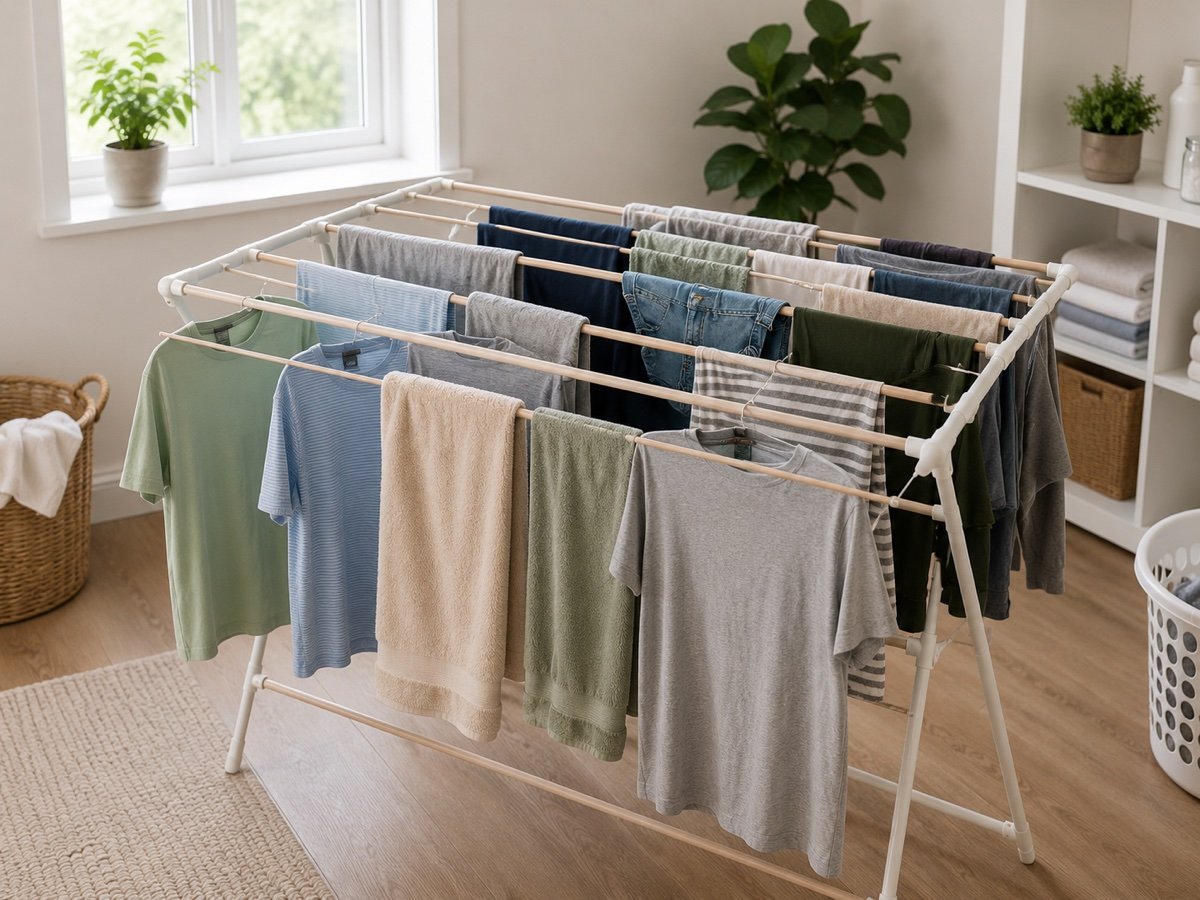
Layered or bunched clothes can dry more slowly where fabric overlaps or stays thickest. Separate items enough for air to move around them, and avoid placing thick pieces on top of one another.
Laundry left wet after the wash cycle
If clean laundry sits wet in the washer before it reaches the rack, the odor may have started before indoor drying. Transfer it promptly when possible. If it already smells musty, follow the care label and appliance guidance before drying it again.
Folding or storing clothes before they are fully dry
A garment that is not fully dry before it is folded or stored can be more likely to develop a musty odor. Check thick seams, cuffs, collars, and folded areas rather than judging only the outer surface.
Detergent or product residue
Too much product or incomplete rinsing can leave residue on fabric or inside the washer. Treat this as a possible contributing factor. Follow the detergent and machine instructions, along with the garment’s care label; adding more detergent is not a reliable first response.
Washer odor or residue
Residue and trapped moisture in a washer can contribute to odor and may affect more than one load. If the washer smells or the pattern is widespread, use the model’s cleaning and maintenance instructions. Do not turn this article into a one-size-fits-all washer-cleaning guide.
What to Do
- Note when the odor appears. Record whether it starts immediately after washing, while the garment is damp, only after it dries, or after folding and storage.
- Check the scope. Compare one item with several items and note whether the same odor affects unrelated loads or the washer itself.
- Move wet laundry promptly. Do not leave a finished load sitting wet in the washer when you can transfer it.
- Check the care label. Use only settings and treatments that suit the garment. Follow product instructions as well.
- Improve rack spacing. Unbunch and separate items so air can move around them, especially thick or folded sections.
- Review the drying location. If it is safe and practical, improve ventilation or air movement. A fan or dehumidifier may help in some rooms, depending on the conditions.
- Let everything dry completely. Check seams, waistbands, cuffs, and other slow-drying areas before folding.
- Keep damp clothes out of storage. Store clothes only when they are fully dry.
- Review product use. Check the recommended detergent amount and whether any product conflicts with the care guidance. Do not add a fixed amount of vinegar, baking soda, bleach, sanitizer, or another additive.
- Check the washer when the pattern is wide. If several loads are affected or the washer smells, follow the manufacturer’s inspection and cleaning guidance.
Change one part of the routine at a time when practical. That makes it easier to tell whether the main clue was drying space, rack spacing, the wash routine, or the washer.
If That Didn’t Work
If a normal rewash did not solve the problem, avoid moving straight to stronger chemicals or repeated treatment. Use the pattern to choose the next branch:
- The same garments only: review their care labels, thickness, seams, and drying position.
- One room only: compare a safe, better-ventilated location and check for persistent room moisture or condensation.
- Several loads: inspect detergent/product use and the washer according to its manual.
- The washer smells: use the manufacturer’s cleaning and maintenance instructions; seek appliance support if the odor persists.
- The odor began before drying: indoor air-drying is less likely to be the first cause, so revisit the wash and washer checks.
- Visible mold, persistent dampness, or equipment problems: address the room or appliance issue through appropriate housing or professional support.
Do not assume that an odor alone proves mold is growing in the garment, and do not use a universal bleach, vinegar, baking soda, stripping, or sanitizing recipe.
Prevention
- Transfer washed clothes promptly when possible.
- Avoid crowding or layering items on the drying rack.
- Choose a suitable drying location with reasonable ventilation and air movement.
- Check thicker areas before folding.
- Store clothes only when fully dry.
- Follow the care label and recommended product amount.
- If several loads develop the same odor, check the washer rather than changing only the drying location.
For more laundry troubleshooting, see the Laundry troubleshooting hub.
Sources
- US EPA — What are the main ways to control moisture in your home? — indoor moisture, ventilation, air movement, and moisture-control context.
- NICE — Recommendations for indoor air quality at home — conditional ventilation guidance when air-drying clothes indoors.
- Whirlpool — How to Remove Smells in a Front Load Washer — wet laundry, residue, washer odor, prompt transfer, and model guidance.