
Quick Answer
If gym clothes smell clean when dry but stink once you put them on, warm up, or start sweating, the timing is a useful troubleshooting clue—not proof of one universal cause. Start by checking whether the problem affects one garment or several. Then review the fabric, detergent and product history, drying routine, and washer if other items are affected too.
The safest first move is to follow the garment’s care label, review the detergent amount for the load, avoid products the care label advises against, remove activewear promptly, and dry it completely. If the washer smells or several loads have the same problem, inspect it using the manufacturer’s instructions.
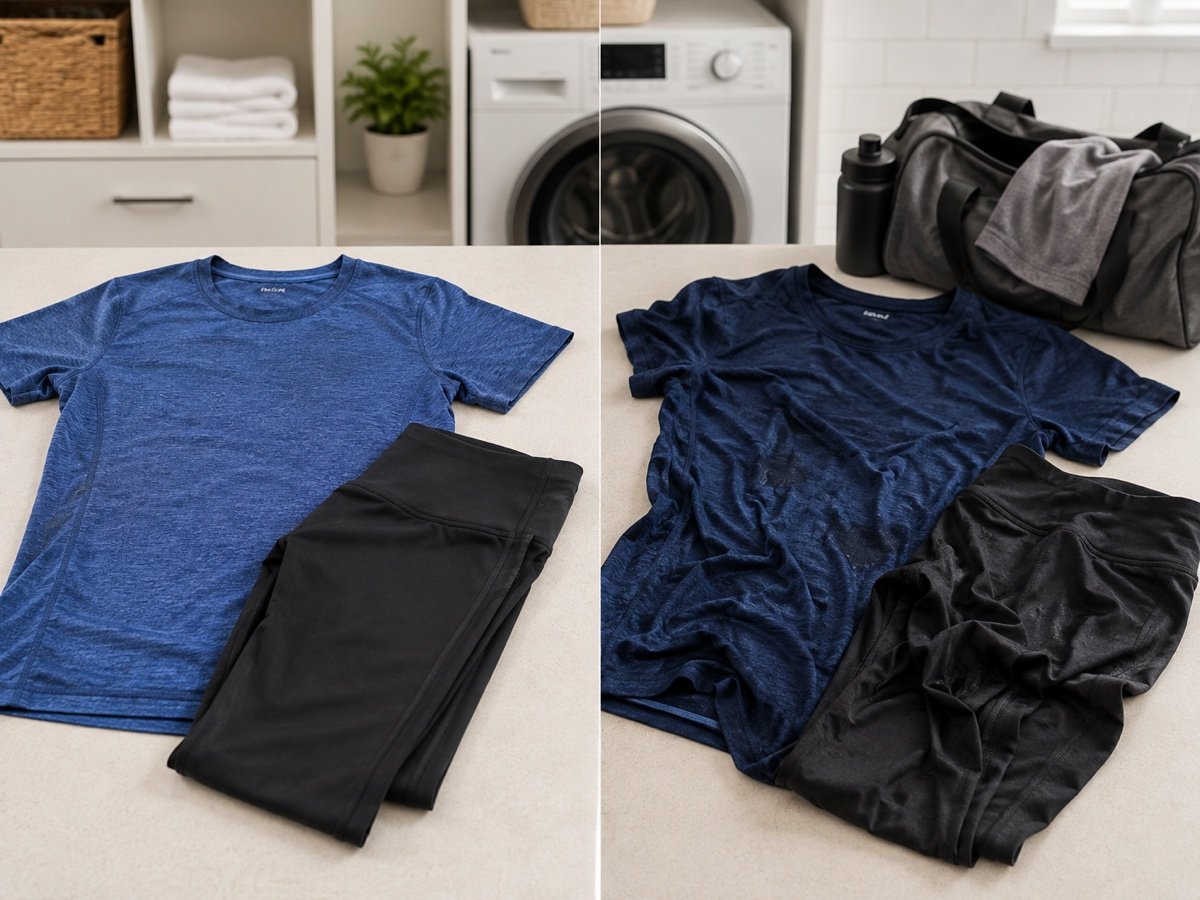
Quick Diagnosis: When does the smell return?
The point at which you notice the odor helps decide what to check first. It does not identify the cause on its own.
Mainly after you put the garment on or begin sweating
The garment’s fabric, prior product use, and whether the issue is limited to one item.
Immediately after washing
Detergent amount, load size, wash settings, and whether the washer itself smells.
After drying
Whether the garment dried fully and whether the drying method matched its care label.
After storage
Whether it was completely dry before storage and whether the storage area has enough airflow.
Across several workout items or loads
The wider wash process and the washer, not just one garment.
Garment or washer: the first scope check
Before changing several things at once, look for a pattern:
- One garment or a few items: Start with the care label, material, detergent and product history, and drying or storage routine.
- Several workout items from different loads: A wider wash-process or washer issue becomes more relevant.
- The washer itself smells: Follow the washer manufacturer’s maintenance instructions. Exact procedures and schedules vary by model.
This comparison is a practical clue, not a laboratory test. It helps you choose where to look first without assuming that the garment or washer has already been identified as the source.
Likely causes to check
Synthetic fabric can be an important clue
Many workout clothes use polyester or other synthetic fibers. In a controlled study of clothing worn during exercise, polyester shirts developed stronger and less pleasant odor than cotton shirts under the study conditions. A review of sportswear research reports a similar pattern across several studies.
That does not mean every polyester garment will smell or that cotton cannot smell. It means the fabric type is worth recording when one activewear item repeatedly smells during wear.
Sweat, body oils, and soil may still matter
Workout clothing collects sweat, body oils, and other soil during wear. Laundry guidance identifies these as relevant factors when odor remains after washing, especially in frequently used activewear. How much odor remains after washing can depend on the garment, the load, the wash routine, and how long the item stayed damp before washing.
Treat this as a reason to review the washing process, not as proof of one specific biological explanation.
Detergent amount and wash conditions
Too little detergent, too much detergent, an overloaded load, or wash or rinse settings that do not suit the garment can all be worth checking. Excess product can also leave residue, but residue is not confirmed as the universal reason a smell returns during wear.
Review the product label and the load rather than automatically adding more detergent. Follow the garment’s care instructions and change one variable at a time when possible.
Fabric softener or dryer-sheet history
Performance-fabric care guidance commonly advises avoiding fabric softener or dryer sheets for certain moisture-wicking garments because coatings can interfere with breathability or wicking. That makes recent softener or dryer-sheet use a useful product-history clue.
It does not prove that softener caused the odor, and it is not a universal rule for every fabric. Let the care label and the garment manufacturer’s instructions decide.
Damp handling and incomplete drying
Activewear that stays bunched in a gym bag, hamper, or washer deserves attention. Promptly remove wet clothing, give it room to air out, and dry it completely before storing or wearing it again. Repeatedly leaving activewear damp or bundled can contribute to recurring odor even when the garment seems fine immediately after washing.
Washer odor or residue
If the same pattern appears across several garments or loads, check the washer. Washer residue, moisture, an overloaded cycle, or a machine that needs maintenance can affect laundry odor. Use the model’s manual for the appropriate inspection and cleaning steps instead of applying a fixed internet recipe.
What to do: a diagnosis-first sequence
- Record the timing. Note whether the odor appears only during wear, immediately after washing, after drying, after storage, or across several items.
- Check the scope. Compare one affected garment with another clean workout item and note whether the washer has its own odor.
- Read the care label. Confirm the safe cycle, temperature, drying method, and product restrictions.
- Check the material. Record whether the item is polyester, nylon, elastane/spandex, a blend, or a special performance fabric.
- Review detergent use. Check the product directions, load size, and whether the machine may have been overloaded. Do not respond by adding more automatically.
- Review softener and dryer-sheet use. If the care guidance advises against them, pause that variable while you evaluate the garment.
- Wash with compatible settings. Use the care label and product instructions rather than a fixed online treatment.
- Remove the garment promptly. Do not leave sweaty clothing bundled or sitting wet in the washer.
- Dry it completely. Use the care-compatible method and do not store the item while damp.
- Check the washer if the pattern is wider. Follow the manufacturer’s maintenance guidance when several loads are affected.
Change one routine variable at a time when practical. That makes the result easier to interpret and avoids turning several guesses into one unclear experiment.
If That Didn’t Work
If you already washed the garment and it still smells when worn, reassess before reaching for a stronger treatment.
First, check whether another workout item has the same problem. Then review the material, detergent amount, softener or dryer-sheet history, wash conditions, drying, and storage. If multiple garments or loads are affected, give the washer branch more weight.
Do not assume that one failed rewash means the garment must be discarded. If the item remains the only affected piece after appropriate care-label-compatible washing and complete drying, replacement may eventually be practical based on its condition, age, performance, and continued odor.
Prevention
- Follow the activewear care label and product dosing directions.
- Avoid incompatible softener or dryer-sheet use when the garment guidance says to do so.
- Remove workout clothes promptly and let used items air out instead of keeping them bundled while damp.
- Dry garments completely before storage.
- Maintain the washer according to its manufacturer’s instructions when a wider pattern appears.
- When the odor pattern changes, reassess the timing instead of repeating the same treatment automatically.
For more laundry troubleshooting, see the Laundry troubleshooting hub.
Sources
- PubMed Central — Microbial Odor Profile of Polyester and Cotton Clothes after a Fitness Session — peer-reviewed polyester/cotton odor comparison under exercise-study conditions.
- Whirlpool — How to Wash Workout Clothes — activewear washing, drying, product, and washer guidance.
- REI — How to Care for Your Sports Bra — performance-fabric care, softener, rinsing, and drying guidance.